If your knee clicks, aches or feels a bit “off” after every Sunday match, you are not alone. Most casual players wonder if they actually need knee support for football, or if that is just something serious athletes wear.
Short answer
Casual players can benefit from knee support just as much as pros, sometimes more, because we do not train our joints every day. But the right support depends on how your knee feels.
Why casual players are more knee-prone
Playing once a week means your knees go from “resting” to full sprints and sudden changes of direction with almost no warning. Professionals train their joints daily and build up strength and stability. Weekend players skip that build-up completely.
That is exactly why knee tweaks are so common in Sunday league football. Not because something is seriously wrong, but because the joint is not used to sudden, repeated stress.
“Your knee is not broken. It is just not used to Sunday.”
Quick check
Do you actually need knee support?
Not everyone does. Find your situation below.
Green light
Mild soreness
Soreness after matches but no sharp pain? A basic compression sleeve is usually enough.
Amber
An old injury
Had a knee injury before? A more supportive brace with side stabilisers is worth considering.
Red light
Sharp pain
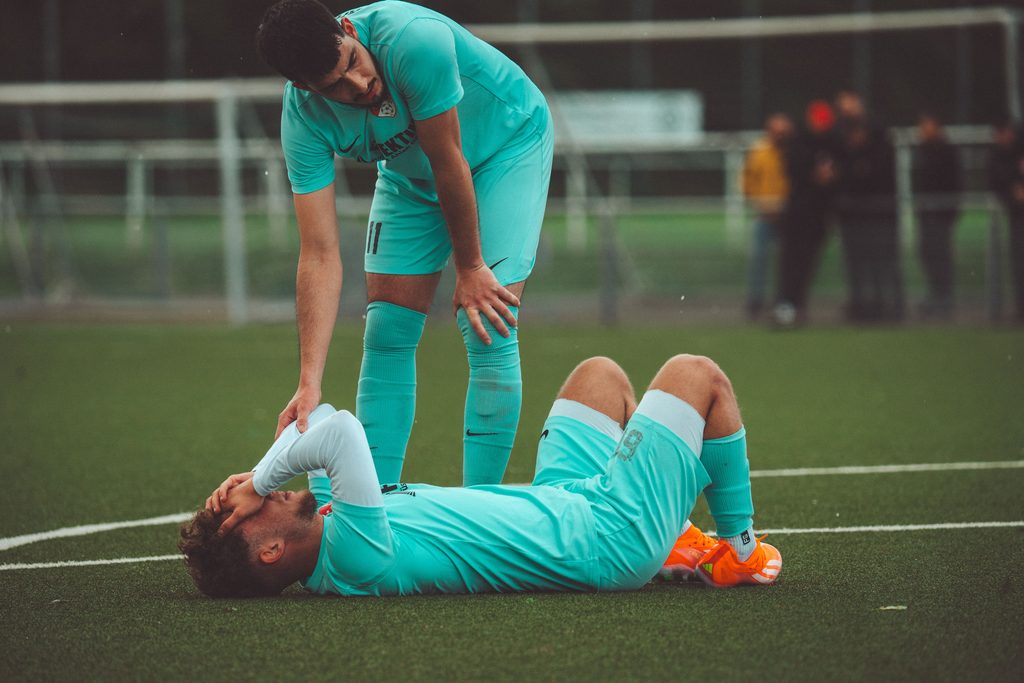
Sharp or sudden pain while playing? That is a sign to see a physiotherapist, not to add a sleeve.
The options
Types of knee support worth knowing
- Compression sleeve · ± €15: the most common option. Light, breathable, improves blood flow and reduces swelling. Good for general soreness.
- Hinged knee brace: more rigid, with extra support on the sides. Better if you had a ligament problem before.
- Kinesiology tape: a cheaper, flexible option for light support without bulk.
Where most people go wrong
Getting the right size
Many players buy a sleeve, wear it once and give up, because it slid down during the match or was so tight their leg went numb. That is the wrong size, not a bad product.
01
Measure
Measure around your kneecap in centimetres with a tape measure.
02
Compare
Check the size chart of the brand. Do not guess from your clothing size.
03
Test
Too loose gives no support. Marks on your skin or a tingling foot means it is too tight.
How to know if it is working
Knee support will not take away pain completely, and it is not meant to. It should reduce swelling, make your knee feel more stable when you turn, and make the day after a match less stiff.
Do
- Start with a simple sleeve
- Wear it during and a few hours after the match
- Combine it with a warm-up
Avoid
- The most expensive “technical” brace
- Wearing it to hide real pain
- Guessing your size
When to stop and see someone
Knee support is for normal wear and tear, not real injuries. If your knee gives way, swells up within a few hours of a match, or you cannot put weight on it, no sleeve will fix that. Let a physiotherapist or doctor look at it.
Quick questions casual players ask
Can I wear knee support if I have no pain?
Yes. Many players wear a light compression sleeve to prevent problems, especially later in the season when matches add up. It also reduces everyday wear on the joint.
How long should I wear it after a match?
A few hours is usually enough for most casual players. Some people wear it to bed on the night of a match if the swelling feels worse than usual.
Not medical advice. Sharp pain, swelling or pain that lasts longer than a few days? See a physio or GP.
A simple routine
Start simple. Upgrade only if your knee asks.
A compression sleeve during the match and for a few hours after, plus basic stretching before kick-off, is enough for most casual players. You will notice the difference by Monday.
Affiliate link: I may earn a small commission. Read more.
Leave a Reply